Patented Liquefaction Technology
for LH₂, LNG & Power Islands.
JTurbo has developed a twin turboexpander cryogenic platform designed to improve the energy economics of liquefaction and support modular deployment across selected LH₂, LNG, Bio-LNG, and Data Center behind-the-meter Power Island applications.
Founded to solve
the hydrogen cost problem.
Jacob Thomas founded JTurbo in Houston in 2020 with a specific engineering goal: reduce the specific energy consumption of liquid hydrogen production below the threshold that makes green hydrogen commercially competitive.
The result is the Twin Turboexpander Reverse-Brayton Cycle — a patented architecture that achieves 5.3 kWh/kg for LH₂ and 300 kWh/ton for LNG. Both figures are independently verifiable against published industry benchmarks. OEM performance guarantees are available to all clients.
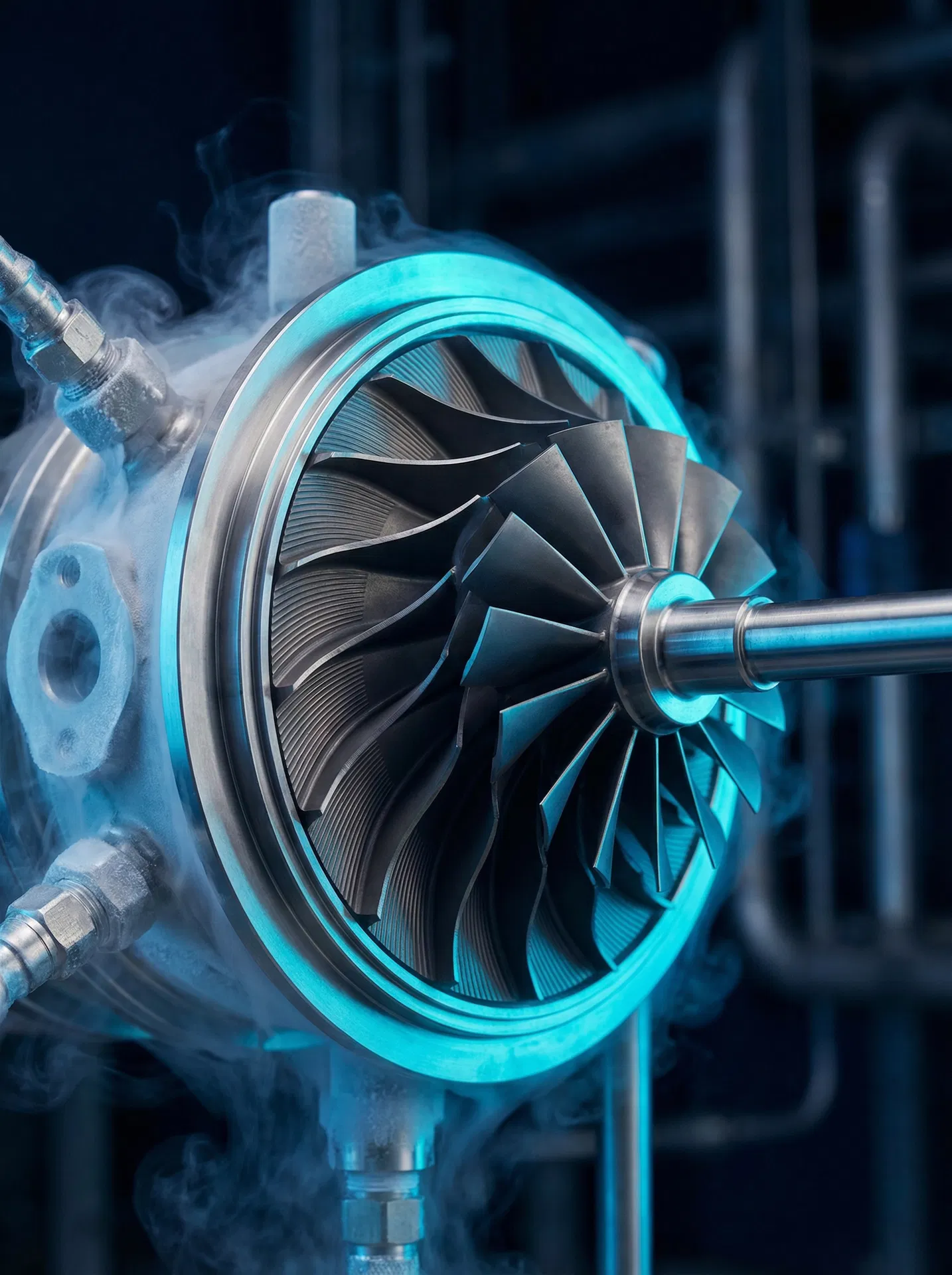
One patented platform.
Three critical applications.
JTurbo has developed a twin turboexpander cryogenic platform designed to improve the energy economics of liquefaction and support modular deployment across selected LH₂, LNG, Bio-LNG, and Data Center behind-the-meter Power Island applications.
Feed Gas Preparation
Hydrogen or natural gas is purified and conditioned for cryogenic duty before entering the main liquefaction architecture.
Pre-Cooling Strategy
Pre-cooling is optimized to the project basis, leveraging available energy inputs and integration opportunities to maximize efficiency.
Twin Turboexpander Stage
The core platform uses twin turboexpanders operating in parallel to deliver industry-leading thermodynamic efficiency in cryogenic liquefaction.
Liquefaction & Storage Interface
The cold-box and storage handoff are engineered as part of a complete deployment architecture, ready for EPC integration.
Liquid Hydrogen
A liquid hydrogen pathway built around transport, storage, export, and industrial decarbonization economics — delivering 5.3 kWh/kg in standard configuration.
LNG / Bio-LNG
Modular liquefaction for natural gas, biomethane, landfill gas, and distributed LNG — where efficiency and modularity drive project economics.
Power-Constrained Infrastructure
Liquefaction-enabled energy architectures for data centers, industrial facilities, and remote power applications requiring fuel storage and grid independence.
Hydrogen
Liquefaction
5.3 kWh/kg Specific Energy Consumption — 50–65% below any incumbent system. Three configurations are available depending on pre-cooling source and site constraints. All configurations carry OEM performance guarantees.
Standard LH₂
LNG Pre-Cooled
LN₂ Pre-Cooled
Competitive Landscape
| Company | SEC (kWh/kg) | Capacity | Est. CAPEX |
|---|---|---|---|
| Legacy Industries | 11–15 kWh/kg | 15–30 TPD | High CAPEX |
| JTurbo | 5.3 kWh/kg | 10–150 TPD | ~50% lower CAPEX |
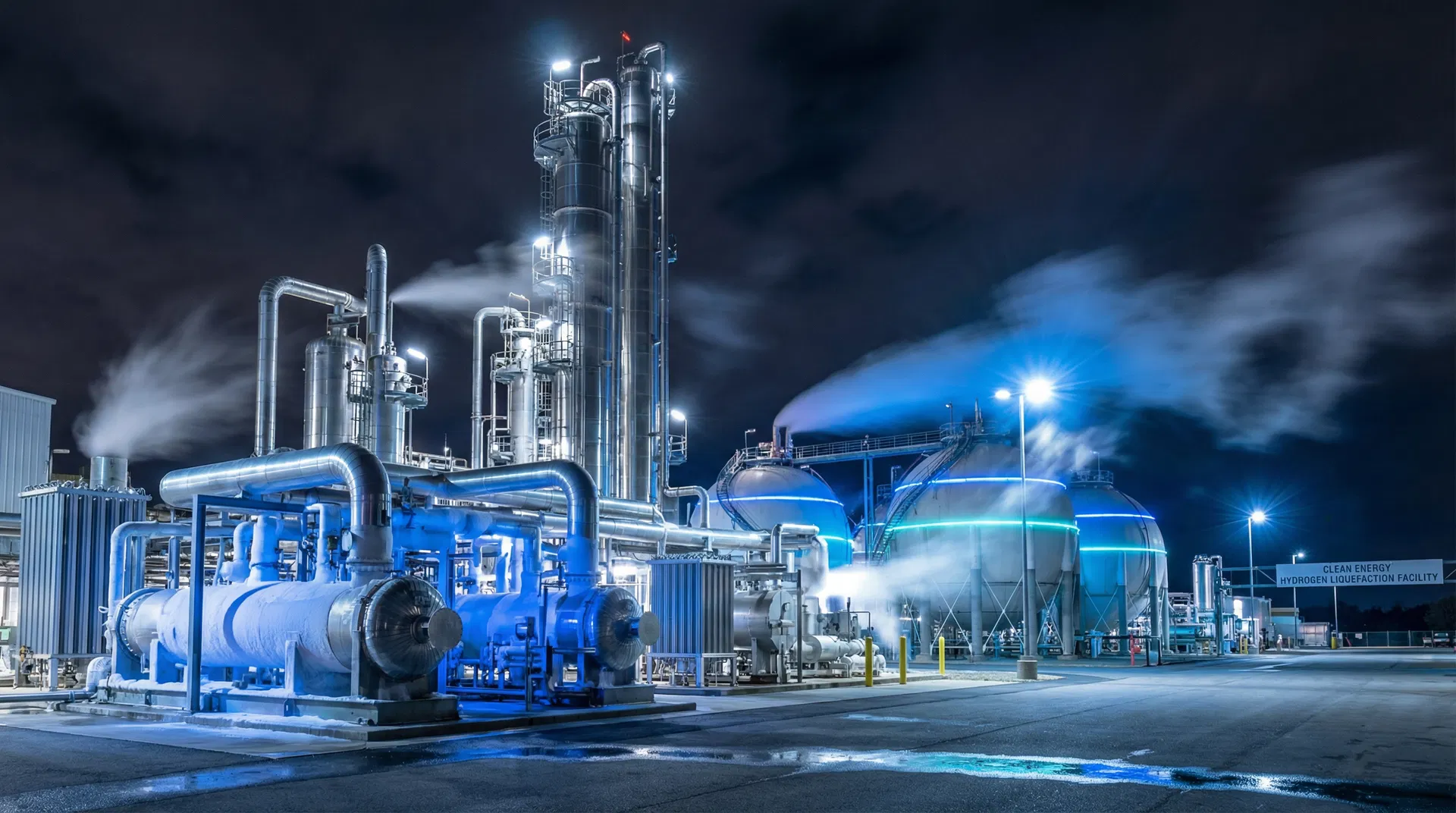
LNG Liquefaction — 300 kWh/ton
Pure nitrogen refrigerant — inherently safe, inert, non-flammable. Modular and scalable from 15 to 3,000 TPD, deployable on land or offshore. 300 kWh/ton SEC with OEM performance guarantees.
Key Performance Metrics
vs. Legacy LNG Technology
| Company | SEC | Capacity | Est. CAPEX |
|---|---|---|---|
| Legacy Industries | 500–600 kWh/ton | 50–3,000 TPD | High CAPEX |
| JTurbo | 270–300 kWh/ton | 15–3,000 TPD | ~50% lower CAPEX |
Target Applications
Floating LNG (FLNG)
Compact, modular design ideal for offshore FLNG vessels. Pure N₂ refrigerant eliminates flammable refrigerant risks on marine platforms.
Stationary LNG Plants
Scalable from 15 to 3,000 TPD. Competitive with mixed-refrigerant systems at a fraction of the complexity and operational risk.
Bio-LNG
Liquefaction of biomethane from agricultural waste, landfill gas, and wastewater treatment — enabling carbon-negative LNG for transport and industry.
Data Center Power
On-site LH₂/LNG production for behind-the-meter power generation at hyperscale AI data centers, bypassing grid constraints entirely.
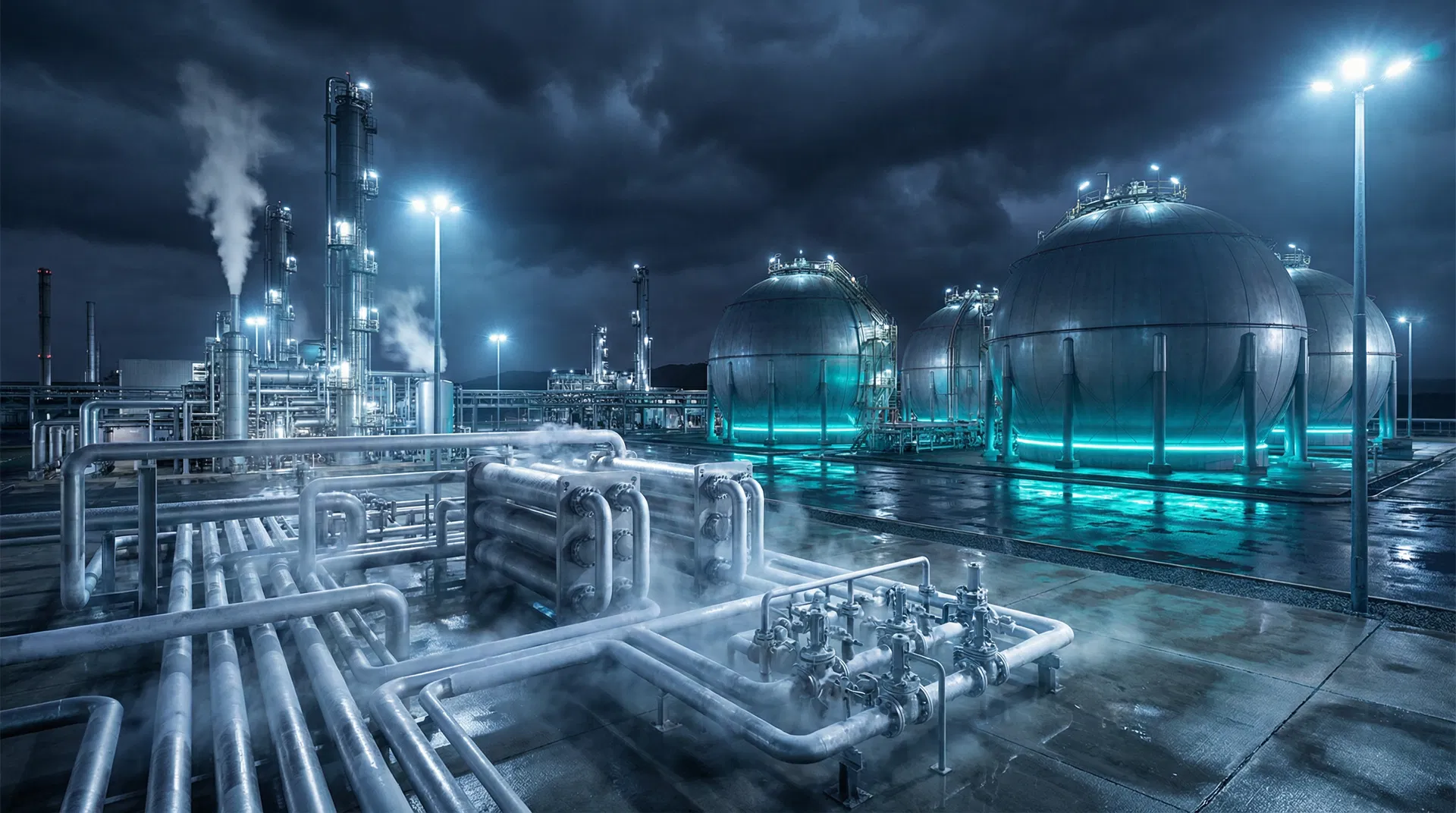
OEM-guaranteed
energy performance.
JTurbo has developed a twin turboexpander cryogenic platform designed to improve the energy economics of liquefaction and support modular deployment across selected LH₂, LNG, Bio-LNG, and Data Center behind-the-meter Power Island applications.
Where the platform applies.
JTurbo has developed a twin turboexpander cryogenic platform designed to improve the energy economics of liquefaction and support modular deployment across selected LH₂, LNG, Bio-LNG, and Data Center behind-the-meter Power Island applications.
Modular LNG Liquefaction
For onshore, distributed gas, stranded gas, and small-to-midscale LNG opportunities where modularity and energy efficiency improve project economics.
Bio-LNG and Methane Monetization
For landfill gas, agricultural waste, wastewater gas, and biomethane sources where liquefaction converts distributed methane into transportable low-carbon fuel.
Hydrogen Liquefaction
For hydrogen storage, transport, export, and industrial decarbonization — delivering lower liquefaction energy that materially improves delivered hydrogen economics.
Behind-the-Meter Fuel and Power
For large-load sites where grid constraints, resilience requirements, fuel security, and thermal integration justify an on-site LNG or LH₂ energy architecture.
Four markets.
One platform.
JTurbo has developed a twin turboexpander cryogenic platform designed to improve the energy economics of liquefaction and support modular deployment across selected LH₂, LNG, Bio-LNG, and Data Center behind-the-meter Power Island applications.
Green Hydrogen
Electrolysis-based green H₂ requires liquefaction to be economically transportable. JTurbo's 5.3 kWh/kg SEC makes LH₂ cost-competitive with grey hydrogen for the first time.
Hyperscale Data Centers
AI compute demand is outpacing grid capacity. On-site LH₂/LNG using JTurbo technology provides reliable, dispatchable power independent of constrained electricity grids.
Floating LNG (FLNG)
Pure N₂ refrigerant is inherently safe for offshore FLNG — eliminating the fire/explosion risk of mixed-refrigerant systems on marine platforms.
Industrial Decarbonization
Steel, cement, chemicals, and refining cannot electrify directly. Green hydrogen as LH₂ is the only viable pathway to deep decarbonization for these sectors.
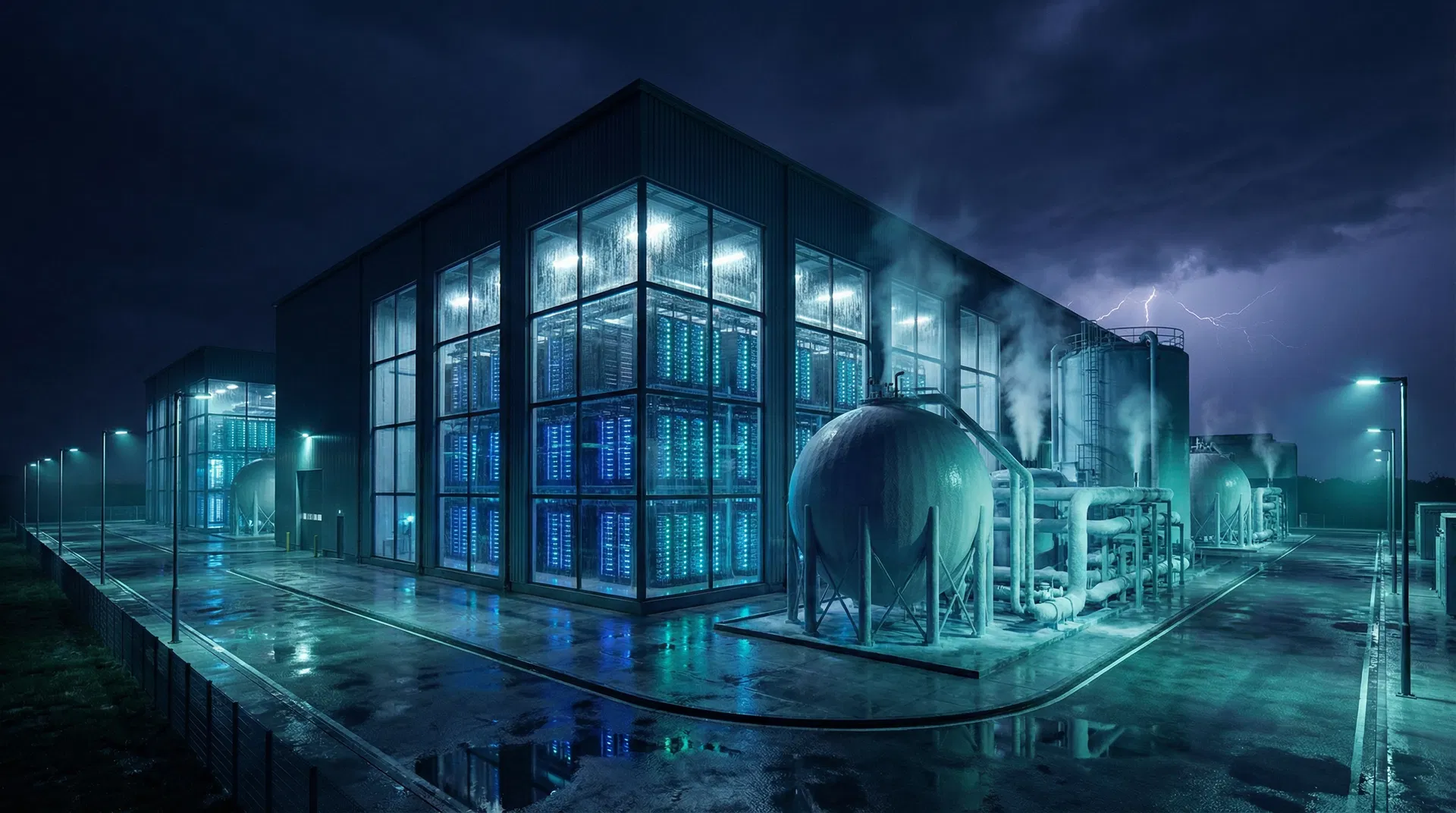
3–7 Day On-Site Fuel Reserve
JTurbo's on-site LH₂/LNG production provides immediate, dispatchable, behind-the-meter power — independent of grid constraints. On-site storage provides full-load backup for 3–7 days with no external supply chain dependency.
Why Not Diesel
Diesel generators are inadequate for modern hyperscale AI facilities: fire/explosion hazard at scale, supply chain vulnerability, NOₓ/SOₓ emissions that violate air quality permits, carbon intensity that disqualifies ESG-compliant roadmaps, and 30–90 second startup latency incompatible with tier-4 uptime and additional CAPEX (for Diesel Gen sets).
Scalable from 10 MW to 500 MW+
JTurbo's modular architecture scales from small edge data centers to the largest hyperscale campuses. Multiple liquefaction trains can be deployed in parallel, each independently operable — providing N+1 redundancy at the fuel production level.
Active discussions across six continents.
JTurbo has active engagements and technical discussions across the USA, EU, India, Middle East, Africa, and Australia — each at a different stage of commercial and technical development.

LH₂ for green ammonia and industrial decarbonization; data center LNG; refinery hydrogen applications.
Green H₂ for DRI steelmaking; offshore wind-to-LH₂ storage; Bio-LNG from agricultural waste.
Green ammonia export; industrial hydrogen for refining; LNG distributed gas monetization.
Blue/green H₂ export; LNG capacity expansion; behind-the-meter power infrastructure.
Green H₂ export hub; renewable energy storage; distributed LNG for industrial applications.
LH₂ export to Japan and Korea; solar-powered hydrogen production; stranded gas monetization.
From technical review to first liquid.
JTurbo is positioned as a technology platform and commercial counterpart for projects that may move from qualification into licensing, FEED, and delivery integration.
From technical review into FEED, licensing, and delivery integration.
Commercial discussions can progress from technical review into FEED, licensing, and delivery integration. JTurbo works alongside established engineering and EPC teams to support projects from qualification through commissioning.
Performance
The team behind the platform.
JTurbo combines proprietary technology with deep cryogenic engineering expertise and an established delivery ecosystem.
Jacob Thomas founded JTurbo in 2020 with the goal of making cryogenic liquefaction commercially viable at modular scale. He leads the company's technology development, commercial strategy, and project qualification activities.

40 years of proven expertise in helium and hydrogen liquefaction and cryogenic storage. Quantum Technology supports JTurbo on FEED studies, detailed engineering, and equipment specification.
JTurbo works alongside established EPC contractors and engineering firms to support project execution from FEED through commissioning and handover.
Request a Technical Review.
If your project involves LNG, Bio-LNG, LH₂, or power-constrained infrastructure, JTurbo can run a structured technical review to determine whether the platform is a fit — before any commitment to licensing or FEED.
Contact Information
We'll review your project details and respond within 2 business days. If there is a potential fit, we'll schedule a structured technical review call at no cost or commitment.